|
[ Geographical Maps in the Article are not to scale, only indicative and no politcal significance]
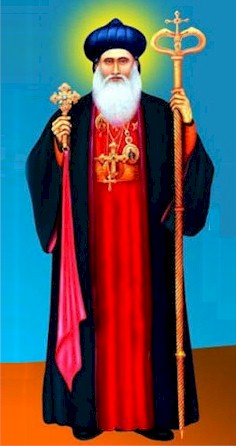
In 1685, Saint Yeldo Mar Baselios arrived in Kerala, dedicating his final days to the spiritual benediction of the region. Though his earthly ministry on Malabar soil spanned a mere thirteen days, his tomb has remained a profound source of grace and pilgrimage for successive generations following his demise. Within the broader ecclesiastical history of the Syriac Orthodox Church, seventy-seven Maphrianos have governed the eastern jurisdictions of the Antiochian See. Consecrated specifically to oversee the Church's expansive eastern zone, Saint Baselios distinguished himself as the 61st prelate to hold this high office. He was born in the village of Kooded (historically Bakudaida), near Mosul in Iraq around 1593. Historically and ecclesiastically, Kooded is a famous place where Mar Thoma Shmuni and her seven children suffered martyrdom. At a very young age he joined the Mar Bahanan Monastery and become a monk and grew in ascetic discipline.
In 1662 Patriarch Moran Mar Ignatius Abdul Masiha I was elevated to the patriarchal throne of Antioch, a position he held until 1686. In 1678, Patriarch Mor Ignatius Abdul Masih I consecrated Yeldo Mar Baselios as Maphrian, after which he established his official residence at the Mor Mattai Monastery near Mosul. His ministry, however, was marked by significant hardship. On one occasion, the Governor of Mosul imprisoned Mor Yeldho alongside two monks, George and Isaac, due to unauthorized renovation work at the monastery, and forced them to pay a heavy fine.
While attending the consecration of the Holy Myron at the Mor Hananyo Monastery (the Saffron Monastery) in 1684, Mor Yeldho took part in a crucial discussion. Following an urgent request from Marthoma II, the church leadership addressed the need to send bishops to India to support the Malankara Church, which was then enduring a period of severe pressure and persecution by the Portuguese. Despite his advanced age, Mor Yeldho volunteered for this demanding mission.
The Backdrop in Malankara: Subjugation, the Synod of Diamper (1599) and Coonan Cross Oath of (1653):
To understand why Saint Yeldo Mar Baselios undertook his arduous mission in 1685, we need to ponder on Coonan Cross Oath of January 3, 1653. This singular specific historical event in India was a revolutionary turning point that fundamentally severed the St. Thomas Christians from Latin Catholic dominance and directly triggered their search for canonical alignment with the Antiochian See.
For over a millennium, the St. Thomas Christians of Kerala (the Nasranis) operated as an autonomous community. They maintained an East Syriac (Persian) liturgical tradition while their local administration was governed by a hereditary native leader known as the Archdeacon. This equilibrium was shattered with the arrival of the Portuguese. Under the Padroado system (royal patronage), the Portuguese crown sought to Latinize the Indian Church. In 1599, the Portuguese Archbishop Aleixo de Menezes convened the forced Synod of Diamper. This synod systematically:
-
Severed Malankara’s historic ties with Middle Eastern patriarchs.
-
Condemned native East Syriac customs and burned ancient liturgical texts as "heretical."
-
Imposed Jesuit bishops and European Canon Law over the local community, effectively reducing the native Archdeacon to a powerless subordinate.
The Catalyst: The Mystery of Ahatallah:
By 1652, the oppression had reached a breaking point. The native Archdeacon, Thomas Parambil, sent desperate appeals across the Middle East for a bishop to restore their hierarchy. In response, a mysterious prelate named Ahatallah arrived at the port of Mylapore (Chennai) in 1652, claiming to be sent by the Patriarch of Antioch. Before Ahatallah could reach Kerala, Portuguese authorities arrested him, put him in chains, and boarded him onto a ship bound for Goa. When word reached the Nasranis that their long-awaited bishop was being held captive at the port of Mattancherry (Kochi), over 25,000 armed St. Thomas Christians marched to the harbor, demanding his release. The Portuguese panicked, barred the fortress gates, and secretly sailed the ship away. Rumors quickly spread that the Portuguese had drowned Ahatallah in the Arabian Sea.
Fury gripped the Nasrani community, On January 3, 1653, led by Archdeacon Thomas, gathered outside the Church of Our Lady in Mattancherry. They tied rope to the open-air granite cross. Holding the rope the entire assembly swore a historic, solemn oath: they would never again submit to the Jesuit bishops ("Paulists") or the religious authority of the Portuguese. Following the revolt, the Nasranis took a radical canonical step. On May 22, 1653, twelve priests laid their hands on Archdeacon Thomas, elevating him as Mar Thoma I, the first native metropolitan of the Malankara Church. Desperate to validate and legitimize the native episcopate of Mar Thoma I (and his successor, Mar Thoma II), the remaining independent faction - the Malankara Church - renewed their letters to the East.
It was this exact, thirty-year canonical vacuum that Saint Yeldo Mar Baselios and Mar Ivanios Hidayatullah finally arrived to fill in 1685. By ordaining native clergy under the West Syriac tradition, they successfully healed the canonical fracture left by the Coonan Cross Oath. Saint Yeldo Mar Baselios arrived in India in 1685 to represent Syriac Orthodox Church of Antioch (historically referred to by outsiders as the "Jacobite" Church)
The 1685 Mission: Journey from the Middle East to India:
In 1683, Mar Thoma II, the Archbishop of Malankara, dispatched an urgent appeal to the Antiochian See detailing the severe hardships endured by the Malankara Syrian Church under intense Portuguese Roman Catholic pressure. Responding to this plea, Saint Yeldo Mar Baselios - though advanced in age at 92 years old - commenced the vital rescue mission. To bypass Portuguese blockades and hostile colonial fleets, the delegation traveled via a discreet and grueling route. The core historical figures accompanying Saint Baselios from the Middle East included his brother Jamma, two dedicated monks named Joea (also referred to as Jocko) and Matthew from the Mor Behnam Monastery, and the newly consecrated Bishop Mar Ivanios Hidayatullah. Setting out from the historic Monastery of Saint Matthew on Mount Alfaf, the group trekked south to Basra. From there, they traveled by sea to Surat before finally making landfall at Thalassery in North Kerala. Due to the constant threat of colonial persecution, they traveled on foot through the hazardous, dense hill tracts of the Western Ghats to reach the inland stronghold of Kothamangalam.
Geographical Overview of the Route:
The epic journey of Saint Yeldo Mar Baselios and his companions spanned thousands of miles across volatile maritime trade routes and hostile colonial territories.
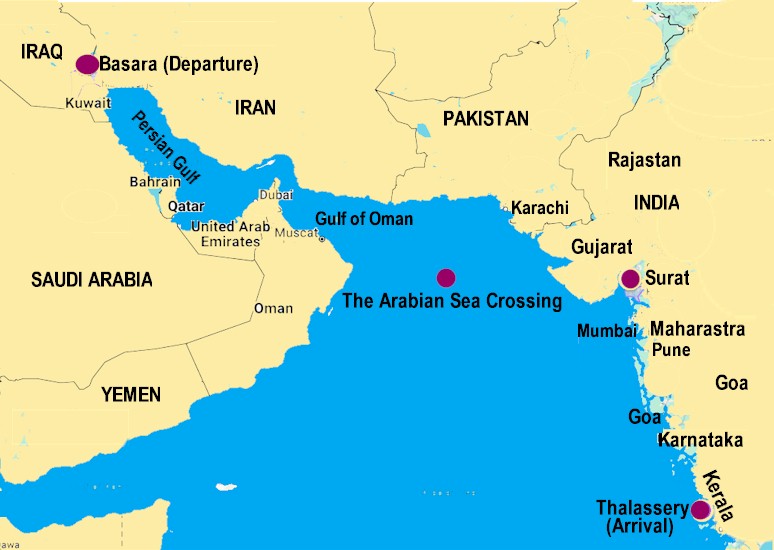
Travel Route of Saint Eldo Mar Baselios Bava
-
The Middle Eastern Transit (Basra, Iraq): After departing from the Monastery of Saint Matthew near Mosul, the delegation traveled southeast through Mesopotamia to the historic port city of Basra. Positioned at the head of the Persian Gulf, Basra served as their primary maritime gateway, allowing them to board a merchant vessel bound for the Indian subcontinent.
-
The Arabian Sea Crossing: The expedition sailed down the Persian Gulf, navigating through the Strait of Hormuz and out into the vast expanses of the Arabian Sea. This maritime stretch required extreme discretion to evade Portuguese naval patrols that heavily monitored Indian Ocean trade lanes during this era.
-
The First Indian Landfall (Surat, Gujarat): The ship docked at the bustling, cosmopolitan port of Surat on the western coast of India. At the time, Surat was a major trading hub under Mughal rule, providing a safer haven from Portuguese interference than ports further south like Goa.
-
The Southern Voyage to Malabar (Thalassery, Kerala): From Surat, they secured passage on a coastal vessel traveling south along the Konkan coast. They bypassed the heavily fortified Portuguese strongholds and safely made landfall at Thalassery (historically Tellicherry) in North Kerala. This landing point placed them within the culturally receptive Malabar region, from where they began their final, arduous overland trek through the Western Ghats toward Kothamangalam.
Treacherous Trails and Early Miracles:
The journey through the wilderness was marked by profound hardships, and tradition records that only three members of the original party survived to reach Malankara (Yeldo Mar Baselios, Mor Ivanios, and Monk Matthew). During their trek through the mountains, Saint Baselios is said to have driven away a wild tiger with a simple sign of the Cross. Later, while resting at Pallivasal near Munnar, the saint was enlightened by divine grace and warned the local villagers of an impending disaster. He advised them to seek shelter in the higher hills; those who heeded his warning survived a massive, devastating flash flood that swept through the valley that night.
The Thirteen Days in Kerala: Traditions and Miracles:
Upon reaching the banks of the Kothamangalam River at Chakkalakudy, the exhausted travelers encountered a Hindu gentleman named Chakala Nair tending cattle. Saint Baselios inquired about the path to the local church. The herder, hesitant to leave his livestock unattended, was astonished when the saint drew a large circle on the ground with his walking stick, instructing him to herd the cattle inside where they would remain entirely safe. Realizing he was in the presence of a holy man, Nair mentioned that his sister was suffering through an intensely painful, complicated labor. The saint offered water, and a double miracle ensued: a nearby coconut tree miraculously bent down so Nair could easily pluck coconuts to refresh the travelers, and his sister safely gave birth back at the village.
To this day, the descendants of the Chakkalakkudy Nair family honor this encounter. The eldest member of the family holds the traditional ceremonial lamp and leads the grand Rasa (church procession) during the annual feast of the saint.
When Saint Baselios finally entered the St. Thomas Cheriapally in Kothamangalam, local traditions hold that the church doors opened of their own accord and the bells began to toll spontaneously. Local residents rushed to the church to find out what the commotion was about. This took place on the 11th of Kanni in the Malayalam calendar (late September) in the year AD 1685. Saint Eldo Mar Baselios entered the church and sat on the steps of the Madbaha (sanctuary). A young deacon who was fluent in Syriac was present. When the deacon realized that an Episcopa (bishop) had stayed behind at Kozhipally, he and some members of the congregation set out for that location. They took a handkerchief from the Saint to use for identification.
When the bishop saw the crowd approaching, he became frightened, assuming they had killed the Bava (holy father) and were now coming for him. Consequently, he refused to climb down from the tree. However, the deacon offered him the sign of peace and spoke to him in Syriac. Reassured, the bishop climbed down from the tree and returned with the people to the church.
On the thirteenth day of the month of Kanni, the church traditionally celebrated its foundation day. On the evening of the twelfth, the Vicar sought permission from Saint Eldo Mar Baselios to hoist the flag. The Saint replied that the Feast of the Holy Cross should be celebrated on the fourteenth, rather than the thirteenth. When the people explained to the Saint that they were not celebrating the Feast of the Holy Cross, but rather the anniversary of the founding of the parish, the Saint permitted them to proceed. However, he reminded them of the great importance of the Feast of the Holy Cross.
Recognizing his failing health, Saint Baselios acted swiftly. On September 27, 1685 (14 Kanni in the Malayalam calendar), the feast of the Holy Cross, Mar Baselios Yeldho Bava consecrated his faithful associate, Episcopa Mar Ivanios Hidayatullah, as Metropolitan to ensure the continuity of the Apostolic tradition of Malankara Church. Mar Ivanios, who was consecrated by Mar Yeldho, carried on apostolic work in Malankara for eight years. He passed away in 1693 and was buried at the Mar Thoman Church, Mulanthuruthy
Demise and Lasting Legacy:
The immense physical toll of the journey overthrew the elderly saint's strength. Three days after the consecration, he fell gravely ill, received the final sacraments, and passed away on September 29, 1685 at the age of 92. It is recorded that at the precise moment of his departure, the massive granite cross in the church courtyard was miraculously illuminated.
He was entombed within the sanctuary of the Kothamangalam Cheriapally. Following his death, his mission was seamlessly carried forward by Archbishop Mar Ivanios. In 1685 Mar Ivanios is consecrated by St. Baselios Yeldo, in 1686 Mar Ivanios consecrated Mar Thoma III and in 1688 Mar Ivanios consecrated Mar Thoma IV. Though earthly ministry in Kerala of St. Eldo Mar Baselios lasted a mere thirteen days, the Saint left an indelible mark on the identity of the Malankara Syrian Church, and his tomb remains an active epicenter of pilgrimage and intercession.
On November 2, 1947, the Malankara Orthodox Syrian Church canonized St. Yeldo Mar Baselios (also known as Kothamangalam Bava) and St. Parumala Mar Gregorios Metropolitan as saints. His Holiness Moran Mar Baselios Geevarghese II, the third Catholicos of the East, made both declarations.
Later, on October 20, 1987, Patriarch Ignatius Zakka I Iwas proclaimed that St. Yeldo Mar Baselios Bava be included in the 5th Tubden (the diptych or official list of saints) of the Syriac Orthodox / Jacobite Syrian Christian Church. On that same date, October 20, 1987, Patriarch Ignatius Zakka I Iwas also officially declared St. Parumala Mar Gregorios a saint within the Syriac Orthodox Church.
The Memorial Feast of St. Yeldo Mar Baselios - popularly known as the Kanni 20 Perunnal or Dhukrono - is a major annual celebration in the Syriac Orthodox and Malankara Jacobite Syrian Orthodox traditions. It honors St. Yeldo Mar Baselios (affectionately called Kothamangalam Bava), the Maphrian (Catholicos) of the East who traveled from Iraq to India in 1685 to revive and protect the Malankara Church. Primary Sanctuary: Held at the Mar Thoma Cheriya Pally (Kothamangalam Cheriyapally) in Kothamangalam, Kerala, India, where the saint's sacred tomb is enshrined. The commemoration begins with the solemn flag-hoisting ceremony, evening and morning prayers, and the celebration of the Holy Qurbono led by Metropolitans, Archbishops, and parish vicars. Thousands of pilgrims of all faiths undertake foot pilgrimages and gather at the tomb seeking the saint's intercession. Traditions include the distribution of Pachor Nercha (sweet rice offering) to devotees, elephant pageages paying homage at the tomb, and communal meals (Sneha Virunnu).
May the intercession of Saint Eldo Mar Baselios be a fortress for us and for the Church. Amen.
(If you liked the Article please share it with your friends, subscribe for Updates or Send your Feedback clicking button below]
 Subscribe for EMail Updates / Send Feedback Subscribe for EMail Updates / Send Feedback |
|
|